

Let’s Talk ‘Protect Thacker Pass’ and Other Native Environmental Justice Movements
Activists Sued by Mining Company Tell Their Stories
Commonalities across these phrases, movements, efforts, and actions? They are rooted in Native origins and Native led efforts from across Indian Country. Having unwavering commitment to a cause for clean air and water, unfracked land, and balance between humans and the natural environment in intention of cohabitation for generations to come.
It is important to use language in the appropriate and proper context for which it has originated. ‘Land Back,’ for example, has significantly been co-opted by non-Native users in an attempt to justify actions other than returning stolen Native land to Native people across Indian Country. This misuse can lead to a diluted understanding of ‘Land Back’ and have a severe impact on true Land Back actions led by Native leaders and tribal nations.
Environmental justice remains at the forefront of many Native Indigenous led efforts. Today, we see fights for salmon rights, water protection, and anti-lithium mining amongst the highest priorities of AI/AN tribes and Native activists. Despite Native activists and tribal leaders often facing the full force of private companies and governmental efforts to push aside tribal sovereignty and land protection rights of Native people, the resistance remains. In Paiute lands of Nevada, many land protectors have been closely watching and actively opposing the lithium mining that has been forced onto traditional tribal lands by mining corporations and with the backing of the United States government’s legal system. Thacker Pass is a site that holds traditional food and medicine and is an ancestral gathering place of the Northern Paiute and Western Shoshone people. Thacker Pass is also the location of a massacre of Native people executed by the U.S. Cavalry in 1865; the Native remains of that massacre remain there today.
In an article titled Lithium mine’s approval violates international rights agreement, says Human Rights Watch, Jeniffer Solis writes, “Under international human rights laws, Indigenous community members have the right to return to their traditional and ancestral land and practice their cultural traditions and religion. The Northern Paiute and Western Shoshone peoples have a deep cultural connection to Thacker Pass or “Peehee mu’huh,” which translates to “rotten moon” in honor of their ancestors who were massacred by the U.S. Cavalry in 1865 in an area of the pass shaped like a moon. It’s also one of the few remaining places in the Great Basin where tribal citizens can still gather traditional foods such as chokecherries, wild potatoes and onions, and traditional medicines like the toza root. Thacker Pass is now fenced off with a four-strand barbed wire fence and ‘No Trespassing’ signage installed every 500 feet. All access gates are locked, or directly supervised by on-site security.” (Nevada Current, 2025)
The article states that no tribal consultations were made between the mining company and the Nevada tribes that have ties to Thacker Pass and further describes the lack of protections for Indigenous people and the loopholes that are taken advantage of on public lands vs. federal lands and for the benefit of private extractive companies. This is an example of how, once again, Native people are at the forefront of fighting to protect the land from extractive uses. In the article, New Report Finds Nevada’s Lithium Mine Permit Violates Indigenous Peoples’ Rights, the ACLU states, “Lithium is a mineral used in the batteries for electric cars and other renewable energy technologies that are considered critical for phasing out fossil fuels and mitigating climate change. But in October 2024, a United Nations panel stated that “urgency of the energy transition cannot justify irresponsible practices in mining” and said that governments should uphold the rights of Indigenous peoples.” (ACLU, 2025) The major surge in electric car manufacturing and purchasing is happening at the expense of Native lives and ongoing land protection efforts by Native people and American Indian/Alaska Native tribes today. Leave it in the ground.
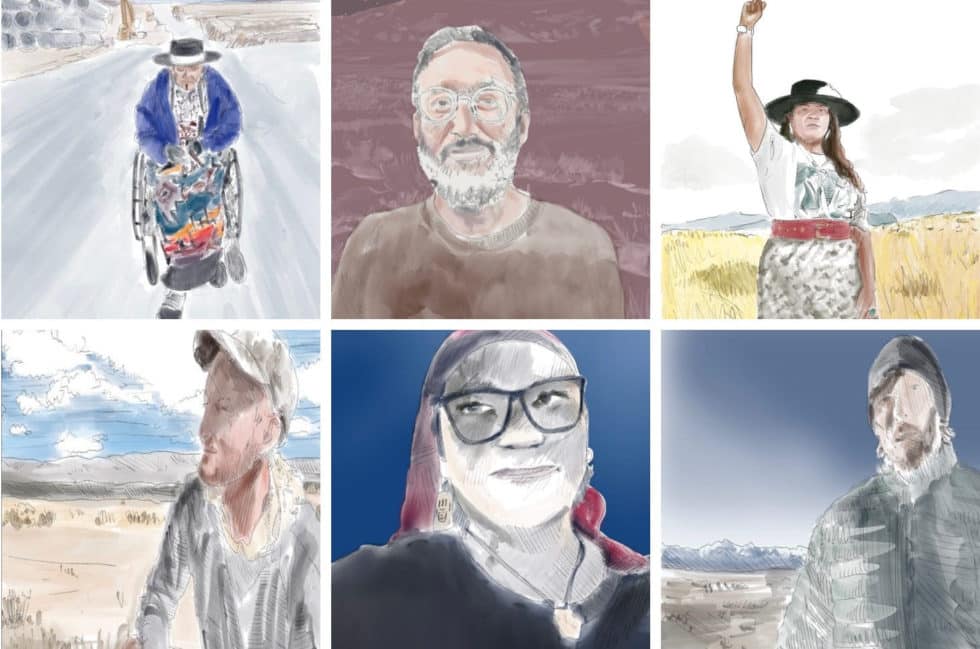
You might be wondering what drew the attention of the United Nations, the American Civil Liberties Union, and the Human Rights Watch to this current issue. This article by Max Wilbert, titled, Press Release: Activists Sued by Mining Company Tell Their Stories, dives into the experiences of the ‘Thacker Pass Six’ who were sued by Lithium Nevada Cooperation in 2023 for protesting the Thacker Pass lithium mine. The Thacker Pass Six talk about the necessary means of action to protect the land from ecocide and irreversible climate change. The article states, “In their court filing earlier this year, Lodge and the other attorneys working on the case made several additional legal arguments, including invoking the doctrine ‘unclean hands,’ asserting that Lithium Nevada Corporation has “engaged in serious misconduct including violating the Defendants’ human rights, Defendants’ civil rights, misleading the public about the impacts of lithium mining and how lithium mining contributes to catastrophic climate destabilization and biodiversity collapse, and conducting the inherently dangerous and ecologically-destructive practice of surface mining at the Thacker Pass mine”. They’re also arguing the “climate necessity defense,” reasoning that by attempting to stop a major mine that will produce significant greenhouse gas emissions, the protesters were acting to reduce emissions and stop a bigger harm: climate catastrophe. According to permitting documents, the Thacker Pass lithium mine is expected to produce more than 150,000 tons of carbon dioxide equivalent per year, roughly equivalent to the emissions of a small city, and amounting to 2.3 tons of carbon for every ton of lithium that will be produced. This legal strategy has been used by many fossil fuel protesters around the world for roughly a decade (and has been successful in a few cases), but this is the first time the same argument has been applied to a so-called ‘green technology’ minerals mining project.” (Wilbert, 2024)
The article includes states from the Thacker Pass Six, as one of the six, author Wilbert says, “Lithium mining for electric vehicles and batteries isn’t green, it’s greenwashing. It’s not green, it’s greed. Global warming is a serious problem and we cannot continue burning fossil fuels, but destroying mountains for lithium is just as bad as destroying mountains for coal. You can’t blow up a mountain and call it green.” (Wilbert, 2024) Bethany Sam, one of the Thacker Pass Six stated, “Our people couldn’t return to Thacker Pass for fear of being killed in 1865, and now in 2024 we can’t return or we’ll be arrested. Meanwhile, bulldozers are digging our ancestors’ graves up. This is what Indigenous peoples continue to endure. That’s why I stood in prayer with our elders leading the way.” (Wilbert, 2024)
On stolen Native land, American Indian and Alaska Native activists remain at the forefront and on the ground of environmental justice movements. It is crucial to stay aware of the tactics that are being used to suppress and oppress Native voices in relation to protecting the Earth, land, and environment. It is also important to support the people who are bearing the brunt of corporate and governmental attacks in their commodification attempts to extract the Earth and exploit the land. Please see the resources linked above as well as those linked below to learn more about the current issues.
Resources:
- Indigenous Environmental Network
- Indigenous Leaders at the Frontlines of Environmental Injustice and Solutions (Giulia C.S. Good Stefani, 2021)
- Wake Up, Stand Up Rally – Mother Earth Day 2025 (CSSP, 2025)
- Celebrating The Legacy Of Native American Activist Hank Adams: A Life Of Activism And Inspiration (Style Rave, 2025)
- Lithium mine’s approval violates international rights agreement, says Human Rights (Jeniffer Solis, 2025)
- WatchNew Report Finds Nevada’s Lithium Mine Permit Violates Indigenous Peoples’ Rights | American Civil Liberties Union (ACLU, 2025)
- Press Release: Activists Sued by Mining Company Tell Their Stories (Max Wilbert, 2024)
- Ivan Bender of the Hualapai Tribe on Sacred Spring of Ha’kamwe’ Threatened by Lithium Mining in AZ (YouTube, 2021)